Gridlocked
Gamers Want Freedom. But Freedom Is Boring.

A while ago, I was climbing a cathedral in Assassin’s Creed Valhalla. It should have been wonderful. A tall medieval structure, full of stone, wood, beams, ledges, carvings, little architectural details begging to be touched. This is exactly the sort of thing games are theoretically good at. They let you do the impossible thing. They let you clamber over history like a squirrel with an axe.
And yet, when I reached the top, I felt almost nothing.
I had not really climbed the cathedral. I had mostly pushed forward and occasionally tapped a button. The game had done the rest. Eivor’s body flowed from ledge to beam to roof edge with the usual expensive competence, and I admired the animation in the same distant way I might admire a well-edited film scene. But I did not feel much ownership over the ascent. I had expressed an intention: go up there. The game had translated that intention into motion.
That is not necessarily bad. It is often exactly what a large open-world game needs. Nobody wants to spend twenty minutes manually negotiating every drainpipe in a Viking theme park. But it also reveals something strange about modern traversal design. We have gained enormous freedom, but much of that freedom is soft. It is generous, fluid, forgiving, and oddly weightless. The world says you can go anywhere, but the act of going there often asks very little of you.
This is the paradox I keep returning to: players want to be free, but real freedom is often boring. Or rather, unstructured freedom is boring. Freedom only becomes interesting when it is constrained by rules you can understand, trust, and eventually exploit.
The grid was not just a limitation
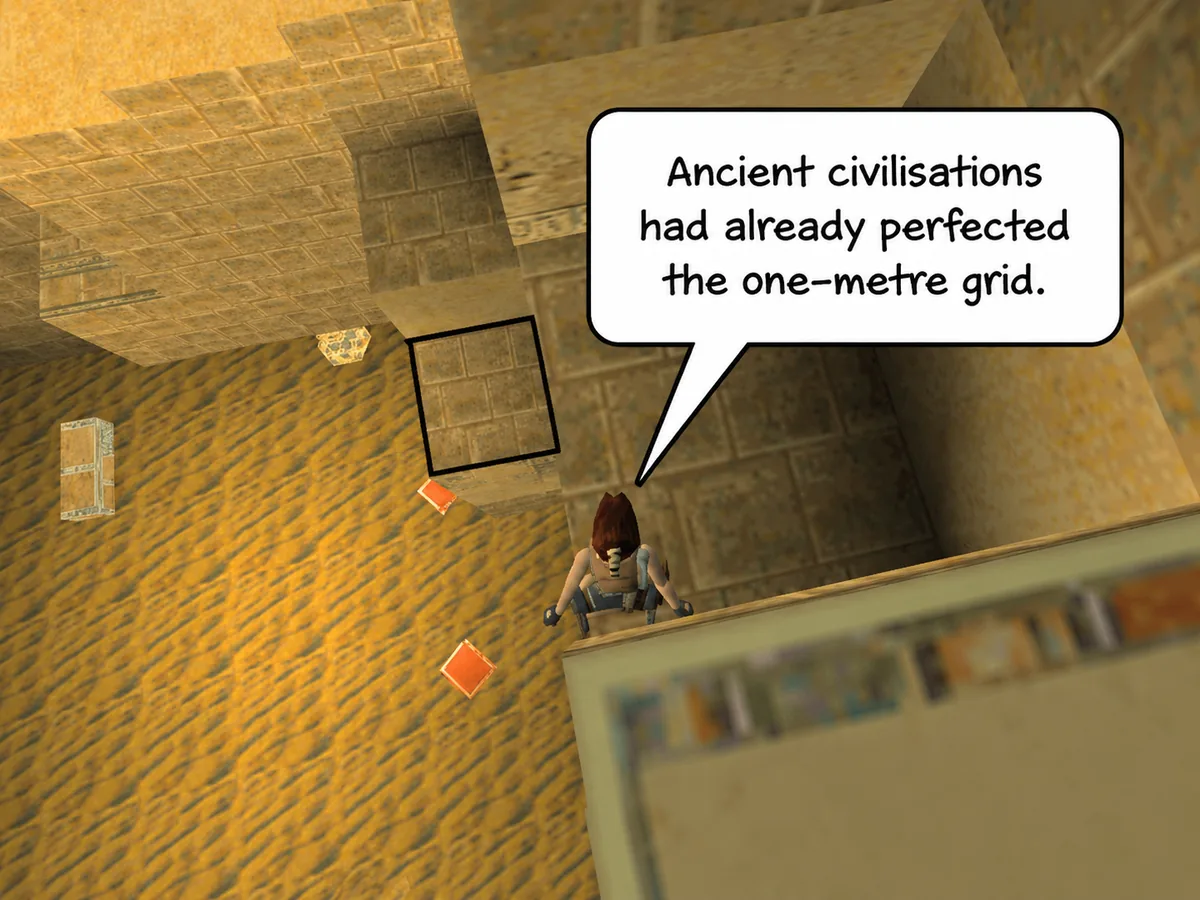
The classic Tomb Raider grid is easy to caricature. Tank controls, square blocks, slow turning, precise jumps, Lara shuffling backwards before a running leap. To modern eyes it can look stiff, primitive, even hostile. There is a reason contemporary 3D games do not usually ask players to perform like that anymore.
But the old Tomb Raider grid had one enormous virtue: it matched the world.
The visible geometry, the collision geometry, and the rules of movement were closely aligned. A block was not merely scenery. It was a measurement. It told you what kind of jump was possible. It told you where Lara could stand, grab, climb, or fall. The level was built out of units that could be read. Once you understood the grammar, you could look at a room and begin to reason about it.
That is why the old grid still feels so precise. It was not precise because the controls were comfortable. They were often not. It was precise because the game made a promise and mostly kept it. If a ledge looked like a ledge, it behaved like a ledge. If a gap was a certain size, it meant something. The game did not always have to highlight the correct route because the route was embedded in the geometry itself.
Active ledge grab was part of that contract. You did not simply drift towards a wall and watch the animation system sort it out. You had to commit. You had to hold the button, make the jump, and hope your calculation was correct. That little requirement kept the player on their toes. It made the moment of contact matter. Lara’s hands catching the edge was not just an animation; it was a judgement.
This is also why failing in old Tomb Raider often felt fair, even when it was brutal. If you missed a jump, you usually knew why. You had misread the distance, mistimed the run-up, or failed to line up properly. If you had let go of the grab button, you fell. The game was not always kind, but it was legible.
The Tetris problem
Tetris is the purest version of this idea. Its visuals and rules are almost indistinguishable. A square block occupies square cells. A line disappears because the row is full. A piece rotates within the same grid that defines the playfield. You do not need to be told what is solid, what fits, or why a mistake happened. The screen is not illustrating an underlying system; the screen is the system.
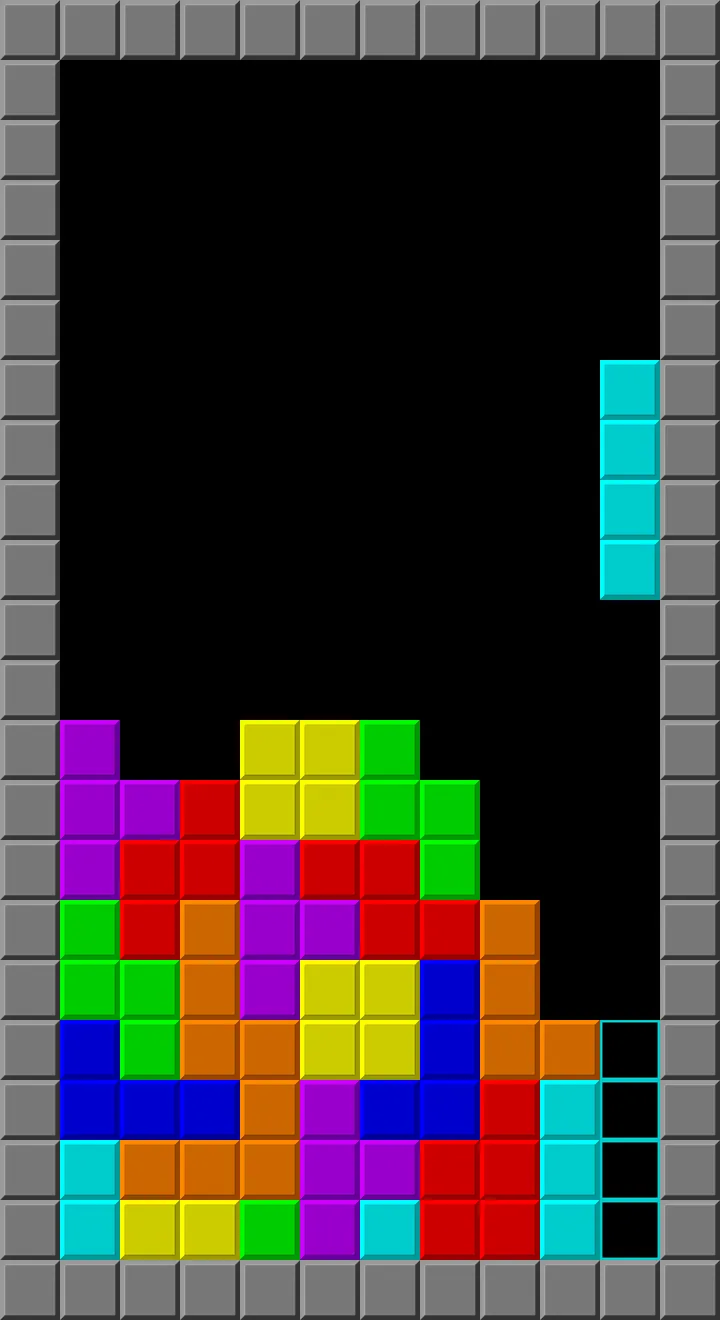
That may also be why Tetris has resisted the usual logic of sequels. You can add modes, music, effects, multiplayer, hold pieces, ghost pieces, garbage lines, and all sorts of modern conveniences, but you cannot easily make the shapes more physically elaborate without damaging the central pleasure. A “more realistic” Tetris with curved pieces, soft-body blocks, friction, rolling, wedging, and tiny gaps between irregular forms might be interesting as a physics toy, but it would no longer have the same crisp satisfaction. It would become a game about interpretation rather than recognition.
Stacking circles in a box may be possible, but it does not produce the same clean mental click as snapping blocks into a grid.
This is the same loss that happened, in a messier three-dimensional way, when traversal games moved away from grid-like worlds. The old Tomb Raider levels were not elegant because squares are inherently magical. They were elegant because the world could be read at a glance. A ledge, like a Tetris block, meant exactly what it looked like it meant. Once environments became more organic, that direct relationship weakened. The game world became more beautiful, but also more ambiguous. The player could no longer reliably infer the rules from the shape of the world itself.
The lesson is not that all games should be grids. That would be absurd. The lesson is that great game spaces need some equivalent of the grid: a visible structure that lets the player predict consequences. Tetris has literal cells. Classic Tomb Raider had blocks, jumps, ledges, and slopes. Breath of the Wild has stamina, surface logic, weather, and broadly consistent climbability. Although some surfaces are too smooth to climb, and it is not always obvious. These are all different contracts, but they serve the same purpose. They let the player look at the world and think: I understand what this is asking of me.
A great traversal system does not need to be blocky, but it does need to be readable. Ideally it matches the way humans read affordances in the real world. Can I climb this? Will it hold my weight? Will it give me traction? All these questions should be answerable at a glance.
The death of the grid
The trouble is that the grid could not survive the move towards more natural 3D worlds.
A grid works beautifully as long as the world is made of blocks. Tombs, ruins, platforms, caves: all of these can be arranged into discrete chunks. But once 3D environments became more organic, detailed, and visually ambitious, the old agreement started to break down. Rocks were no longer really blocks. Walls were no longer really walls. Surfaces could be curved, slanted, irregular, decorative, or simply lying about their true collision shape. The first cracks started to show, in my opinion, with the addition of triangular surfaces in Tomb Raider 3, which sort of worked still, but felt already a bit artificial and stiff.
For a while, developers tried to solve the mismatch of collision geometry with the visuals by marking climbable surfaces directly. Crystal Dynamics’ Tomb Raider games are a useful example here. Instead of relying on the entire world being made of readable units, they made specific ledges readable. The infamous white ledges were not an accident. They were an answer to a real problem.
But they were also an admission of failure.
The white ledge says: do not trust the world, trust the sign. This stone surface and that stone surface may look similar, but only one of them belongs to the traversal system. The game has to mark it because the geometry itself no longer carries the rule. In the old grid, the level was the interface. With white ledges, the interface is painted on top of the level.
This is why the common complaint about white ledges and yellow paint is both right and slightly shallow. The problem is not merely that they are ugly, or that they make games too easy, or that they insult the player’s intelligence. Sometimes they are useful. Sometimes they are necessary. The deeper problem is that they reveal a broken contract between art and interaction.
If something looks climbable but is not, the player loses trust. If something does not look climbable but suddenly is because it has been marked with paint, the player also loses trust. The world stops being a place and becomes a decorated obstacle course. This has deeper implications for suspension of disbelief. You are no longer reading architecture. You are reading developer annotations. In some sense, the curtain has been lifted and you get the feeling of what should be a glance behind the scene or a developer commentary.
The cathedral problem
Modern Assassin’s Creed took a different route. Instead of asking the player to precisely interpret every ledge, it made the traversal system much more flexible. Push towards the surface and the character will usually find a way. The animation system, inverse kinematics, procedural correction, and authored traversal data all work together to make motion look plausible.
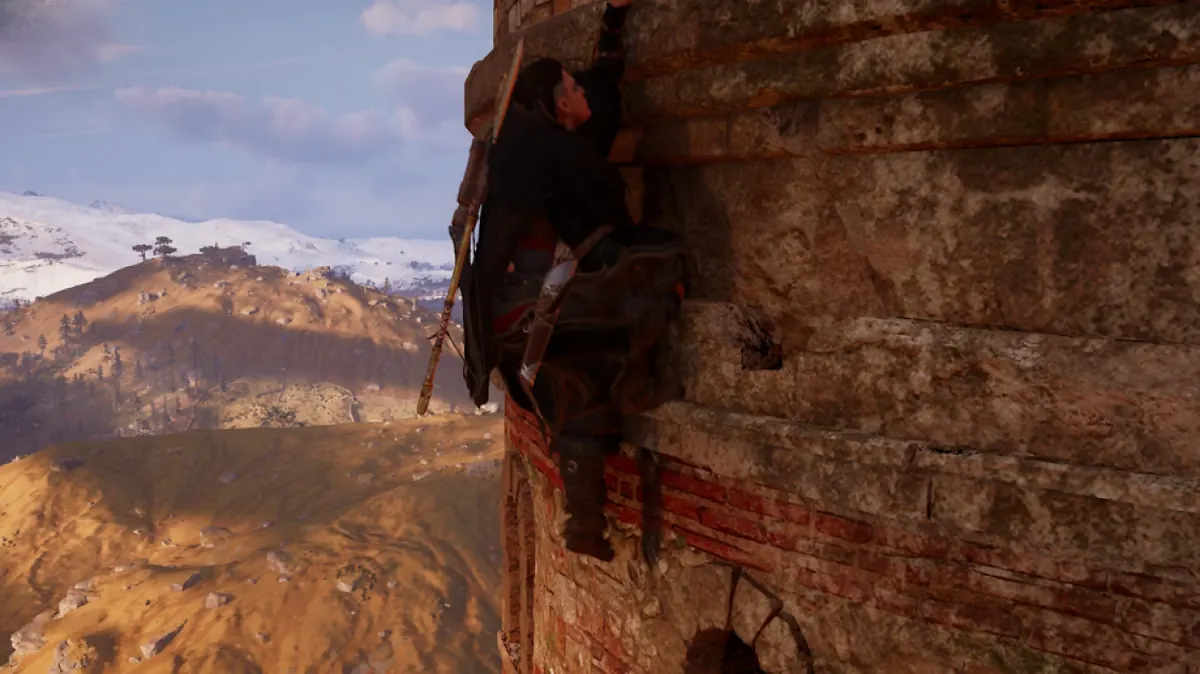
There is a lot to admire here. I do not want to pretend these systems are lazy. They are technically impressive, and in many ways they solved a genuine problem. They allow artists to build worlds that do not look like giant climbing frames. They allow characters to move across irregular architecture without snapping awkwardly from block to block. They give movement a nice rhythm, especially in the better Assassin’s Creed games, where parkour has a flow reinforced by animation and sound.
But they also shift the interesting work away from the player.
In classic Tomb Raider, the player performs the traversal. In modern Assassin’s Creed, the player often supervises it. You indicate direction and intention, while the game handles the details. This is fine when traversal is merely a way to get somewhere. It is less satisfying when the game wants the act of traversal itself to feel meaningful.
That is why climbing a cathedral can feel strangely empty. The destination is impressive, the animation is expensive, the view is lovely, but the ascent has no teeth. There is little sense of route planning, little danger of miscalculation, little pleasure in reading the structure correctly. You are not really solving the cathedral. You are being carried over it.
The game has given you freedom, but it has removed much of the friction that would make that freedom memorable.
White paint is not the real enemy
This is where I think the usual internet conversation around traversal gets stuck. People complain about yellow paint, white ledges, glowing handholds, and other visual markers, and then the discussion quickly becomes a familiar loop. One side says modern games treat players like idiots. The other side says players need guidance and that not everyone wants to rub their face against every wall for twenty minutes.
Both sides are partly right, which is why the argument is so boring.
The real question is not whether climbable surfaces should be marked. The real question is whether the game has a consistent traversal language. Can the player learn the rules? Can they predict what will work? Can they make interesting decisions based on those predictions?
A white ledge is not inherently bad. A white ledge becomes bad when it is the only reason something is climbable. Yellow paint is not inherently bad either. It becomes bad when it replaces world design with signposting.
The best solution is not to remove all markings and call it immersion. That merely creates frustration. The best solution is to make markings unnecessary because the world itself has become readable again.
The contract of traversal
Good traversal depends on a contract between the player and the world.
The contract can be simple. In classic Tomb Raider, it is almost mathematical: these distances, these heights, these ledges, these slopes. Learn them and you can read the level. In Breath of the Wild, the contract is different: most surfaces can be climbed, but stamina, weather, materials, and route planning matter. In a game like Death Stranding, terrain itself becomes the main opponent. Slopes, rocks, rivers, weight, balance, and exhaustion all become part of the journey.
The exact contract does not matter as much as the fact that there is one.
This is where I think modern climbing games sometimes get lost. They want the spectacle of traversal without always committing to the rules that would make it satisfying. They want the player to feel free, but they also want to prevent the player from getting stuck, confused, or annoyed. So the system becomes increasingly permissive. The character finds the next grip. The animation fills the gap. The route becomes obvious, or irrelevant.
But if everything works, nothing matters.
A game does not need to be difficult to be interesting, but it does need resistance. Some surfaces should refuse you. Some routes should be better than others. Some mistakes should cost time, stamina, health, noise, or simply dignity. Otherwise climbing becomes a kind of decorative locomotion. Pleasant, but not really play.
What could better climbing look like?
One obvious answer is to make climbing tall structures into a puzzle again.
A cathedral should not merely be a vertical surface with enough invisible handholds to let you ascend from any angle. It should be a piece of architecture you have to understand. Maybe one side has scaffolding, another has fragile stonework, another has a route that only becomes available after entering from inside. Perhaps some pieces break off. Some surfaces may be too wet, too smooth, too unstable, or too exposed. Perhaps there are multiple routes, each with a different kind of risk.
The point is not to make the process tedious. Nobody wants every climb to become a mini-game where you manually place each finger on a crack in the wall. That way lies QWOP with masonry. The point is to make the player look, plan, and commit.
Another answer is material consistency. If brick can be climbed, brick should generally be climbable. If polished marble cannot be climbed, it should generally not be climbable. If ivy helps, it should help everywhere. If rain makes certain surfaces slippery, it should do so consistently. This does not mean every game needs a full physics simulation of fingers and stone. It simply means the player should not feel that the rules are being invented separately for every object.
A third possibility is to treat climbing ability as part of character progression. Breath of the Wild already does this well with stamina. The player can climb almost anything in principle, but not everything in practice. Better stamina opens routes. Weather closes routes. Equipment changes routes. That is a much more interesting form of freedom than merely allowing the character to magnetically stick to any wall the designers have blessed.
You could imagine similar systems in other games. A character who learns to climb rough stone before smooth stone. A character who needs gloves, hooks, rope, or training to handle particular surfaces. A character who can attempt a risky route but might slip, make noise, or exhaust themselves. This would turn climbing from a background convenience into a real part of the game’s grammar.
The far end of the wall
There is also a more extreme answer: make climbing actually about climbing.
A game like New Heights: Realistic Climbing and Bouldering sits at the far end of this spectrum. It is not trying to make climbing disappear into smooth cinematic movement. It is trying to simulate the problem itself. Grip matters. Balance matters. Body position matters. Hold direction matters. You are not merely telling the character to go up; you are negotiating the wall.
This is fascinating because it almost inverts the modern Assassin’s Creed solution. In Assassin’s Creed, the wall is made legible by generosity. The character can usually interpret the surface on your behalf. In New Heights, the wall is made legible by specificity. The holds are the game. Their shape, angle, distance, and relationship to the climber’s body are not background detail. They are the entire point.
That is probably too much for most adventure games. I do not think Tomb Raider should become a full climbing simulator where every handhold has to be assessed like a bouldering problem. That would be a different fantasy. Lara Croft is not supposed to spend ten minutes quietly calculating whether a limestone nubbin will support a toe hook. At some point she has to shoot a wolf, steal an artefact, or accidentally awaken something that should have remained asleep.
But New Heights is useful as a boundary case. It shows what happens when traversal is treated not as a solved convenience, but as the main source of play. The wall becomes readable again, not through a grid, and not through yellow paint, but through the logic of climbing itself. A protrusion is not decorative. A hold is not merely a place where an animation can snap. It is an opportunity, a risk, a little argument between body and surface.
The interesting question for adventure games is whether they can borrow a small amount of that seriousness without becoming simulations. They probably do not need full climbing physics, but they could use more respect for the wall. More attention to body position. More weight and momentum behind the animations (something modern Tomb Raider definitely lacks!). More meaningful differences between holds. More surfaces that ask to be approached from a particular angle. More routes where the player has to stop for half a second and think: how do I actually get from here to there?
That, to me, is the sweet spot. Not total automation, where climbing becomes decorative. Not full simulation, where every ascent becomes a specialist sport. Something in between: a traversal system that still feels adventurous, but gives the wall enough reality to push back.
Not every game needs traversal with teeth
There is an important caveat here: not every game benefits from making traversal challenging.
In Grand Theft Auto, for example, it would be absurd if climbing a wall suddenly became a careful analogue-stick exercise where you had to control both arms and legs. The core fantasy is not about negotiating architecture. It is about inhabiting a city, stealing cars, causing trouble, and moving through a dense urban space with minimal friction. A more automatic climbing system makes sense there.
The same is true for many open-world games. Sometimes traversal is connective tissue. It gets you from one mission to another. It should feel smooth, not demanding. If every fence, wall, ladder, and rooftop became a little skill test, the whole game would become exhausting.
But games like Tomb Raider, Uncharted, and Assassin’s Creed are different. Their worlds are full of ruins, towers, cliffs, temples, rooftops, cathedrals, caves, and forbidden spaces. They constantly frame traversal as adventure. They want the player to feel like an explorer, climber, thief, archaeologist, or assassin. In those games, traversal is not just transport. It is the fantasy.
And when the fantasy is climbing, climbing should probably involve more than holding forward.
In praise of ledges that keep their promises
I do not want to return wholesale to the old Tomb Raider grid. That would be silly. Modern gamers don’t want to be gridlocked. Contemporary games can do things that 1996 Tomb Raider could only dream of. They can animate bodies with extraordinary nuance, build vast cities, stream enormous landscapes, and make characters move through space with a fluidity that once seemed impossible.
But I do think something was lost when the grid disappeared.
What was lost was not stiffness, awkwardness, or difficulty for its own sake. What was lost was the pleasure of a world whose rules could be read directly from its shape. The pleasure of standing in a room, looking around, and slowly understanding what was possible. The pleasure of knowing that a ledge meant something.
Modern traversal often gives us larger worlds, smoother movement, and more freedom. But freedom without legibility turns into mush. The player drifts through a generous system that quietly solves the interesting parts on their behalf.
The answer is not necessarily to make games harder. It is to make them more trustworthy. Give players rules they can see. Give them worlds that keep their promises. Let them fail for reasons they understand. Let them succeed because they saw something, planned something, and executed it.
Players believe they want total freedom, but total freedom is empty. What they want is a world that pushes back just enough to become worth mastering.